

Juniors across Indiana attempt to pursue the opportunity to graduate early. They take summer classes or skip out on electives to meet graduation requirements.
Only a small number of students go for this option. According to Arizona State University, reports showed that fewer than 3% of U.S. students graduate early.
This statistic partially stems from the varying requirements to graduate early, but another reason why this percentage may be low is the fact that they won’t be able to do everything that seniors can.
“The cons (of graduating early) would be the fear of missing out,” junior Ash Trammell said. “You get a lot of that (as) you’re going to miss out on senior prom and senior sunrise.”
Graduating early already takes a significant amount of effort, but when a student chooses to do so a year early instead of just a semester, it brings to light the benefits and drawbacks of missing your senior year.
When a student chooses to graduate as a junior, there are a few things that they have to be willing to miss out on.
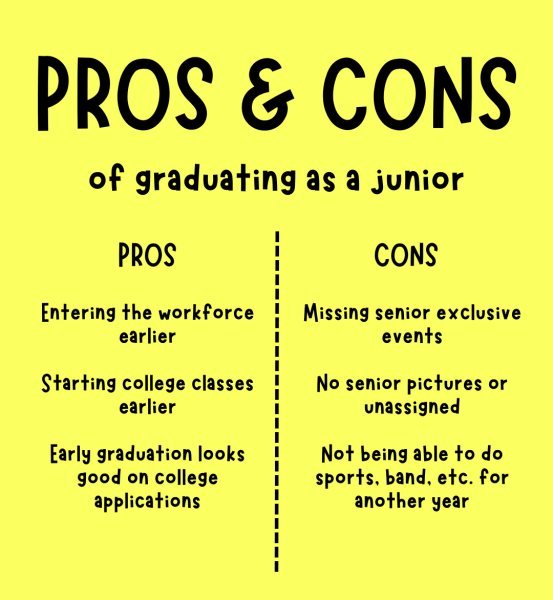
“Being a senior comes with special privileges,” counselor Julie Fierce said. “You get an unassigned study period or a senior picture in the yearbook, you can’t have any of that.”
Although they don’t get to participate in these activities, most early graduates agree that the pros outweigh the cons.
Being able to join the workforce or start college classes earlier is an advantage for the careers that some early graduates plan to move on to.
“Usually you have to work in law enforcement before you can actually become what I want to be, like a forensic pathologist,” Trammell said. “Getting into the workforce sooner is a really big plus.”
While some may think administrators would push for students to graduate early, it can cause a significant problem for the district. Perry Township loses a substantial amount of money as they’re losing students for their headcount.
Every student gives the district a certain amount of money from the state. When a significant number of students graduate early, the district loses out on a part of their budget.
“You do a headcount in the fall and a headcount in the spring,” Principal Amy Boone said. “That’s how much money you get per enrollment financially for a district. If we have a lot of students graduating at semester, we’re losing out on financial support.”
It takes a significant amount of effort to graduate early, and it’s not suitable for every student. Sending out college applications with only three years of high school can often get you overlooked.
Counselors know that this is a lengthy process that takes months to fully arrange, so they talk through it with juniors and their families.
“We talk with (the family) about it,” Fierce said. “We feel that we do the very best thing for students. Everybody’s path can look a little different, and that’s okay.”
