


It started with a feeling, a sudden rush of power when one senior protester stepped out of SHS and into the cold, heavy air lingering among the crowd. Students gathered together with handmade signs, chanting and marching to the front of SHS. This moment carried a weight that hadn’t been there previously.
This scene took place early during the student-led protest on Feb. 2, which unfolded outside the front doors of SHS.
This reaction inside comes in weeks after the killing of Renee Good, who was shot by an ICE agent in January. Soon, the fatal shooting and death of Alex Pretti would follow.
For one student, this walkout was more than a protest. It was proof that the young generation was capable of making a difference.
“Standing at the door before exiting, I looked at every single sign, and they really hit my heart in some way. It makes you realize some people think our generation is stupid, and all these stereotypes surrounding our generation,” the senior said. “But here we were that day making a difference. I really do think it made a difference.”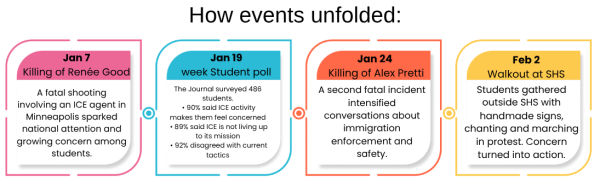
During the week of Jan. 19, The Journal conducted a poll about recent ICE activity and mortality. In the 486 responses obtained, over 90% of students leaned strongly anti-ICE in between the killings of Good and Pretti.
What emotion best describes how you feel about ICE?
While these incidents have been isolated to the city of Minneapolis, several students say they’ve felt the impact first hand.
“I do feel afraid going to school or going out with my friends… There are so many people you hear on the news being taken away, detained, and that could be any of us,” junior Christina Par said. “They’re not just aiming towards “aliens” anymore. They’re attacking and taking away American citizens as well, and you never know, that could be you.”
Par’s fear and feelings of unease is shared by multiple students. Based on the poll The Journal conducted, more than 90% of students said that ICE’s activity makes them feel concerned.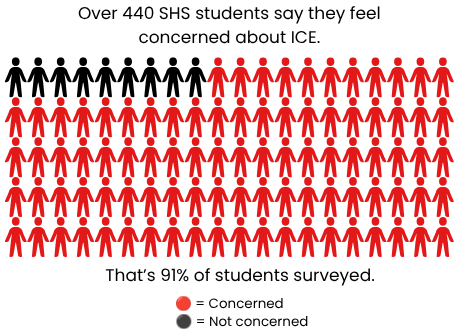
For some students, this concern turns into deep frustration. This frustration is not only because of the violence but at the feeling that nothing is changing.
“I’m angry. I feel like it would be on every American to be angry, especially because the so-called ‘nation of freedom’ is dealing with issues by silencing the press,” senior Taryn Colyer said. “There’s a common belief among citizens that there’s nothing they can do, so they fall into neutrality or empathy, or they just don’t care.”
Teachers have also taken notice of student’s emotional responses to the current events.
Social studies teacher David Luers reports that students are withdrawn and some have expressed a fear that wasn’t present before.
“It affects students who have been targeted or students who are of similar ethnicity or racial background because they fear that despite their citizenship status, they might be attacked because racial profiling has been approved by the Supreme Court for ICE to do,” Luers said. “Some are blissfully unaware that anything’s happening. Others are concerned about what happens if ICE is allowed to keep going unrestrained.”
When social studies teacher Gene Lezon was asked, “do you think ICE creates a negative or positive change,” he says it’s determined on how one sees it.
“It depends on what point of view you want to take it from. Are we addressing the issues of people coming to the country illegally? Are we doing it in a safe manner?…” Lezon said. “That’s kind of another one of those motive questions. I can say yes and no.”
For several students, the focus was not just concern, but on how ICE’s mission was being carried out across the country.
Do you think ICE is upholding its mission statement? “Protect America through criminal investigations and enforcing immigration laws to preserve national security and public safety.”
When asked whether ICE was living up to it’s mission statement of “protecting America through criminal investigations and enforcing immigration laws to preserve national security and public safety,” 89% of students said ICE was not.
“They’re certainly deporting, but the people they’re deporting aren’t who they say they are. I don’t think children are capable of committing cartel crimes, but I may be wrong in that factor,” Coyler said.
For Par, the issue goes beyond policy. Par believes that ICE’s actions have created an environment in which ordinary people feel unsafe in their communities.
“I just don’t think it’s right for people, everyday students, to fear going to school or walking to the street corner to get something. No one should have to wake up and be scared of not being able to see their family or having to make sure they have all the right documents for things. No one deserves to live in fear,” Par said.
On the other hand, junior Braxton Elder believes that ICE has been successful in some areas of embodying their mission.
“I think they’re living up to what they’re saying they were going to do to an extent. You see it all over the media. They’re obviously doing their job of trying to get illegal immigrants out,” Elder said.
Do you agree with the tactics ICE is using as a federal agency?
The poll also shows strong criticism of ICE’s methods. More than 92% of students disagree about the tactics ICE is currently using.
“We have peaceful protests, and I’ve seen them run over people, kidnap them and deport them,” Par said. “I’ve seen them deport American citizens to random countries they’ve never even been to before. I just don’t understand how that’s allowed.”
Par is not alone in her judgement. Junior Bella Hufnagel is also questioning ICE’s tactics.
“It’s just terrible… like at least cops wear body cams, but they (ICE agents) don’t even wear body cams, and they don’t show their faces,” Hufnagel said.
Less than 8% of participants from the poll are not fully critical of ICE’s actions. Students urge caution in how incidents like these are interpreted. Elder noted the situation is not as clear cut as it appears.
“When someone’s life is lost, that’s devastating… but you do also have to take in mind what happened for something like this to happen… I’m not condoning their killing, but every case is different,” Elder said.
Together, these feelings demonstrate the different ways people at SHS are interpreting the same events.
Have you heard about the recent ICE-related shooting death in Minneapolis?
As conversations have grown more urgent, many teachers say their focus has shifted towards helping students understand what resources are available to them and what steps students should take to stay safe.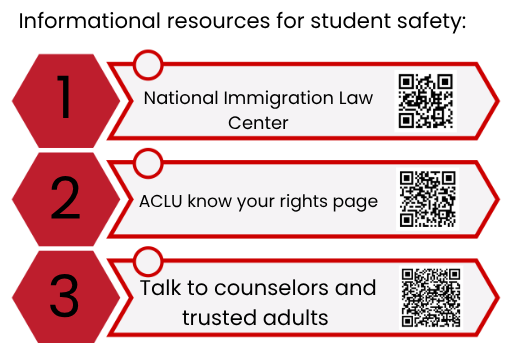
“Multiple teachers have talked about the possibility of needing to shelter students, the possibility of what would we do should ICE come into the building,” EL teacher Ariana Murray said. “We do have resources that we can provide to students, potentially immigration lawyers…Last year, we printed out cards that have individuals’ rights, should ICE come and speak to them so that everyone knows, especially in their language, what rights they have.”
Murray’s concern isn’t only felt by her. EL teacher Amy Peddie also described how the situation affects her and her students in the ongoing crisis.
“I’m very worried for my students. I can’t even imagine what would happen if they came and start getting my students from class. That would be the most awful thing in the world,” Peddie said. “I mean, I am definitely not an immigrant. I’m a white American, but I’m afraid for my job as well.”
In a building where students are protesting and debating policies while teachers quietly prepare for worst case scenarios, what once felt so far away in Minneapolis has become more than distant headlines. They’ve reshaped conversations and how some students think about safety and what could happen inside SHS.
Divided by interpretation but united in attention, SHS has become a reflection of a larger national conversation unfolding in real time.
Elder puts emphasis on having calm and friendly conversations. And not recklessly labeling other people for their stances.
“I think calm conversations are the best conversations, where we’re not angry at each other, we’re not yelling at each other, we’re just having a friendly conversation,” Elder said. “Everybody just needs to hear each other out before they start pointing fingers.”

Jay • Feb 28, 2026 at 1:22 am
Amazing journal