


As students progress through high school, they are often unaware of the information that is used to form the lesson plans for each of their courses. Furthermore, teachers often lack the time to break down the different components that are considered when forming these lesson plans.
“If a student’s going into a class and they don’t really know why they’re there or why the lesson pertains to them or what they’re able to do after the lesson is completed with the information they’ve just received, students sometimes find that that lesson is just annoying and they don’t really know what to do with it,” Assistant Principal Josef Horvath said.
What students may not know is that the content of their lessons derive from the very work they produce in class. Oftentimes, their completed work is analyzed to draw conclusions and construct educational material for the future.”
There are two types of data SHS teachers can look at, s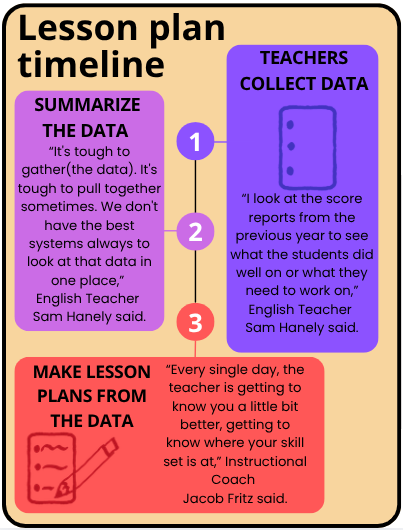 ummative and formative.
Summative data comes from quizzes, homework and tests which helps teachers determine whether or not students are ready for an upcoming performance assignment.
Formative data, however, is collected at the end of the year from SAT or AP test results. The information drawn from these tests helps teachers build effective lessons for the next year.
Regardless of the type of data, each piece of information gives educators a clearer picture of what their students know and don’t know. As teachers find out what their students need, they make their lesson plans around that while also ensuring that their lessons meet state standards and teach a specific skill.
When teachers are unsure of how to teach something, they reach out to instructional coaches who help them interpret the data that they get from the tests and quizzes students take.
“Every single day, the teacher is getting to know you a little bit better, getting to know where your skill set is at,” Instructional Coach Jacob Fritz said.
While interpreting data takes time, it holds importance to teachers because a better lesson means that students learn more.
“I probably use AP data the most. So every year when I start teaching an AP Lang class, I look at the score reports from the previous year to see what the students did well on or what they need to work on. And I assume that that’s probably something I need to teach differently or better.” English teacher Sam Hanley said.
Though data is used in the creation of lesson plans, teachers don’t make their lesson plans all the same way. What works for one teacher might not work for another. It is up to each teacher to find a way that works for them and for their students
“If you feel that a lesson is coming out of the void, it’s most likely because … the teacher didn’t make it explicit why you’re learning that particular thing, but I don’t think any of them plan with no intention,” Horvath said.