

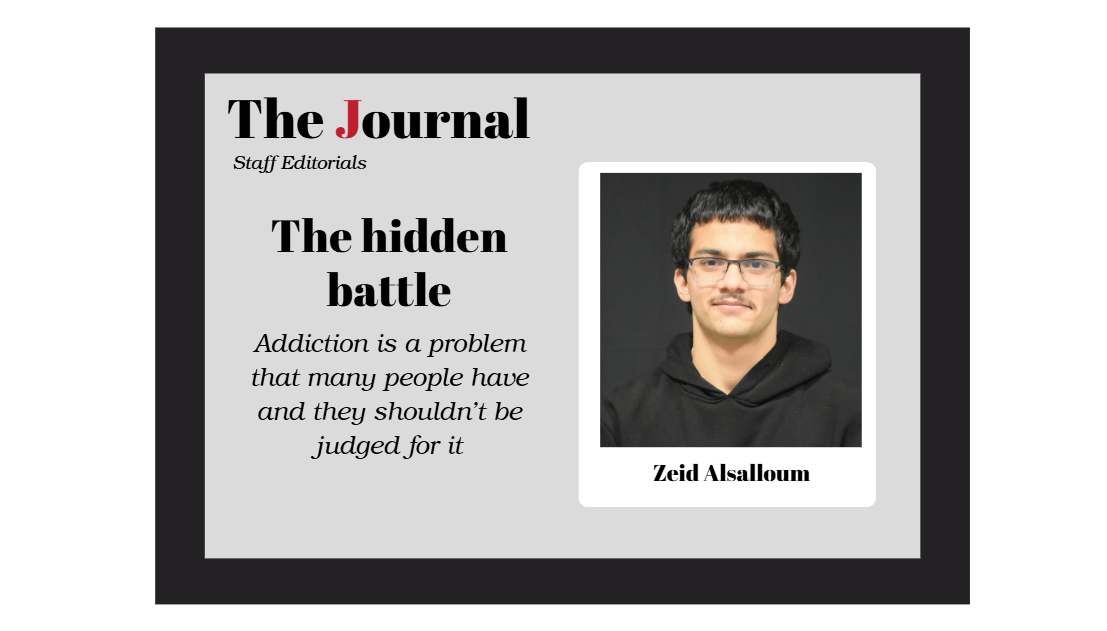
Addiction is one of the most destructive struggles a human can face, and it doesn’t discriminate.
From everyday habits like endless scrolling to something like a life-detracting drug dependency, addiction shows up in many forms.
For me, it’s not just a theoretical issue, it’s personal. I have watched people I deeply care about battle against addictions that affect every part of their lives.
Addiction doesn’t just begin from a single choice. It often stems from stress, loneliness or the need to escape. Many people turn to habits or substances, not realizing how fast dependency can form.
With dependency comes the loss of self.
It can make them lose interest in things they love and distance themselves from the people who care most about them. It could take hold of their mind, pushing them to make irrational decisions under the influence.
From school bathrooms to public areas, addicts are everywhere: people who are struggling, teens and adults who wish they had never started and those who wish they never met the wrong influence who gave them their first hit or drink.
It’s unfortunate. But for some people, it’s their coping mechanism. It’s a gateway to take their mind off their toxic household, unhealthy relationships or the trauma and stress they have been dealing with for years.
But instead of judging those caught in addiction, we need to look closer at what drives it and what we can do to help.
According to the National Institute on Drug Abuse, addiction is a long-lasting condition that often involves relapse. It drives people to keep seeking and using drugs even when they know it will harm them. NIDA explains that it’s considered a brain disorder because it alters the parts of the brain that are responsible for reward, stress and self control.
In other words, the longer someone uses drugs, the brain continues to rewire itself to keep the cycle existent. This is not because they lack willpower, but because their neurology has been altered.
It’s too often that society views addiction as depravity rather than a health crisis. We shame and blame the addicted instead of supporting them, which only makes recovery harder.
The truth is that no one wakes up one day and chooses to form an addiction. It’s usually a slow subsiding process formed from pain, pressure and sometimes unfortunate circumstances.
Addiction thrives in silence. It creeps up when people feel they can’t talk about their struggles without being labeled as “weak,” and they hide it until it is too late.
That’s why open conversations, education and empathy are our best weapons. Schools, communities and families should come together and recognize the problem for early intervention. Punishment and exclusion is not the solution.
Recovery is never easy, but it is never too late for help. It takes time, and it may even require professional help with a strong support system. But when we replace judgment with empathy and provide the right resources, lives can be rebuilt, and the cycle can be broken.
Staying silent only protects the stigma, not the people.
Talking about addiction with honesty and compassion can make someone feel less like a monster and more like a human who is still worthy of a second chance. Maybe that person is a stranger, maybe it is someone in your life or maybe it is you.
Either way, choosing empathy over judgment could be the first step to saving a life.

Lucy Len Dim • Jan 26, 2026 at 1:29 pm
Zeid, wow. This is powerful. Everything from the wording to the emotion in this story speaks so much volume. This is most certainly something that needs to be discussed, and I love that you used your voice to share this!
Lorelei • Jan 25, 2026 at 1:29 pm
Zeid, this is such an incredibly well-written editorial and such a good topic to cover that needs to be brought to light. wow wow wow wow I loved reading it 🙂