

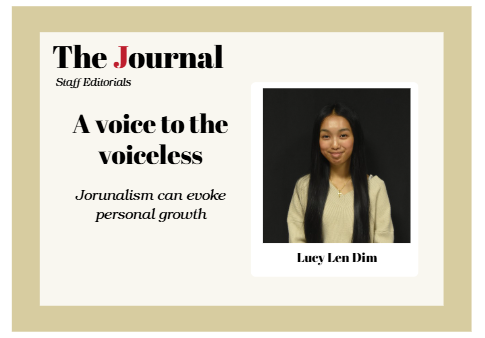
During my freshman orientation, my tour guide stopped to point out Room 400, Southport High School’s newsroom. She then asked the group, “Is anyone taking Journalism?”
My peers all scanned the auditorium lobby, waiting for someone to raise their hand. Everything went silent, until my friend asked me the question I was hoping to avoid.
“Lucy, aren’t you taking Journalism?”
Dang it.
I stayed quiet and ignored her question, hoping that the tour guide would move down the hallway soon.
Thankfully, she did.
I felt relieved knowing that nobody would see me as a nerd or tryhard. But ever since that day, I’ve secretly wrestled with a never-ending sense of guilt.
Today, I serve as the Editor-in-Chief of an incredible publication, one that has introduced me to the power of storytelling. It’s made me fall absolutely in love with all the bits and pieces of journalism, but four years ago, I couldn’t even bear to admit the fact that I was interested in it.
That doesn’t seem fair at all, does it?
How can someone stand at the front of the podium and lead a staff of 34 journalists if they were once ashamed to proclaim their love for journalism?
But now that I look back at it, my experience doesn’t mean that I’m a phony journalist with a late start. Actually, my slow burn love for journalism is a testament to how transformational it has been in my life.
Think about it.
A young freshman who used to be afraid to speak up now motivates her staff to be a voice to the voiceless? Now, that’s a story worth telling.
And it all began when I first made my way inside Room 400 as a student in journalism.
When we began delving into the nooks and crannies of the subject, I felt lost.
Straight up lost.
Don’t get me wrong, the content most certainly piqued my interest. But I just wasn’t expecting journalism to be so intricate and complex.
When the word came to mind, I immediately imagined a notebook and pencil.
But boy, was I wrong.
For one, I had no idea that journalistic writing adhered to its own set of style rules. Trying to retain AP style while also differentiating between the different 1st Amendment court cases stirred confusion in my brain. And trying to understand the concept of a dog being tied to a pole made me feel like I was a lost puppy.
But I wasn’t going to let my lack of understanding disrupt the perfect stream of A’s on my report card. So I continued to write to the best of my abilities.
I eventually got the hang of it, but there was definitely a lot of grey area in my understanding, even if my scores came back high on each assignment.
For some odd reason though, I felt motivated to apply for the school’s newspaper, The Journal, at the end of the year. I wasn’t quite sure what I was getting myself into, but I was excited to add another extracurricular to my resume.
Then, sophomore year hit, and I joined the staff as a Features Reporter. My mind ran in circles trying to figure out what exactly Features entailed, even though I dabbled in it during full-year journalism and earned an A on my feature stories.
Yep, I was definitely behind.
Then the words “beats” and “maestro” got thrown at me, and I felt like I accidentally signed up for a foreign language course.
I remember asking a fellow reporter what all of the terminology meant and they shrugged their shoulders at me, so my only choice was to try and keep up.
I did my best to follow along with all of the inner mechanics of the publication, and it slowly started to make sense. It definitely took some time, but soon enough, asking follow-up questions during interviews felt natural to me, and journalistic structure finally made sense in my head.
But the one thing I couldn’t seem to work my way into was the family-like culture on The Journal.
I absolutely loved the way everyone got pumped up for distribution day in their grainy red Journal t-shirts, and my mind will never forget all of the laughs and giggles that filled the air during production night family dinners. But I just didn’t feel like a piece of the puzzle.
So I worked in silence and isolation.
Even though the newsroom was packed with noise and chaos, it felt like a void to me.
I’d sit in the first row of the left side of the room with fellow reporters on both sides of me, but I tuned out the noise and let it become my rhythm.
Did I enjoy being disconnected? Of course not. But I wasn’t going to knit myself into fabric that didn’t mesh well with my original cloth.
After a year of pushing through in quiet diligence, the preparations for the next one rolled around.
Once again, something from within pushed me to take up on the opportunity to be an editor. Perhaps it was an invisible string of some sort.
And that experience rewrote the narrative for me.
When junior year rolled around, I sat in the same seat but worked with an entirely different perspective.
Every class, I showed up with a smile on my face and excitement in my voice, ready to make the Culture section my own.
And that started with the way I took care of my writers.
They were my babies, and I took it upon myself to hold their hands and walk with them to success. At the time though, I don’t believe neither I nor my writers expected such a hefty deal of trials and tribulations to stand in our way.
Nevertheless, we stood together to brave the storm ahead of us.
We battled through quite literally everything.
In the beginning of the year, we struggled with adjusting to our new roles on the staff, but compared to what was to come, that was nothing.
When production started to pick up, it felt like we were abruptly forced onto the frontline.
Every single one of my writers and I worked with diligence and pure intentions, but this did not exempt us from the wrath of adversity.
With each story I’ve edited, I’ve been able to grasp a tighter understanding of what truly effective journalism looks like. Throughout the story-editing process, I was able to learn from the mistakes I made during my time as a reporter and correct them when I saw my own writers making them. For example, when an anecdotal lede wasn’t compelling enough, I’d ask follow-up questions to help pick at their brains and get some ideas flowing. If a quote was a little too bland, I’d encourage them to revisit their interview recording to search for a more flavorful one. And in the case that the story didn’t align with the original angle, I’d sit down with my writer and pin point where we trailed off and help them get back on track.
Although editing stories was a key component of my time as an editor, designing spreads and graphics also helped me understand that storytelling extends beyond words. As I experimented with different design approaches, I came to the realization that crowded story packages bury the story instead of enhance it. This taught me the importance of being intentional with every graphic and photo I included in a story. Designing also challenged me to think outside of the box and brainstorm creative ways to expand on the meat of the story without adding to the word count.
As I soaked up every bit of knowledge, I got lost in the beauty of it all.
Editing stories and designing spreads soon felt natural to me, and I’d have trouble getting away from my screen because of how invested I was.
I remember staying up until 12 a.m. to finish graphics or edit stories even if my alarm for school the next day was scheduled for 5 a.m.
I spent a ridiculous amount of time after school to clean up my spreads and help copy edit stories. During Issue 6, I even stayed until 9 p.m. after school to finish designing the Teacher of the Year spread because I wanted my work to reflect the definition of “great” instead of simply exemplifying the word “good.”
I meticulously worked under a blanket fort to hide the identity of the teacher, and my eyes grew weary searching for orphans or misspellings in the story.
But it all paid off.
I enjoyed every bit of my time as a section editor, even if it spread me thin some days.
Watching my writers emerge from their shells and blossom into the experienced, diligent, and intelligent journalists showed me that every sacrifice and hiccup was worth it.
By the middle of the second semester, I finally felt like I belonged. Knowing that I made an impact of some sort told me that I served a purpose in the newsroom, and that was all I needed to keep going.
I also opened myself up to new friendships and finally found a community. I no longer sat isolated in the first row of the left side of the classroom; I sat in one of the middle tables with a group of vibrant voices who shared the same love for journalism.
And that’s when I fell in love with the newsroom.
But that was only the beginning.
I couldn’t stop there.
No way.
I wanted to take my love for journalism to the next level, and this meant applying for the top position, Editor-in-Chief.
When my adviser published the leadership application, I knew I couldn’t waste any time. Over the course of the next 10 days, I cranked out a nine-page leadership application, the longest one Journal adviser Mike Klopfenstein has ever seen.
In this application, I poured out my heart and soul, in hopes that my undying love for this publication and journalism as a whole would be crystal clear.
I wrote and wrote and wrote. Every little light bulb in my head and tear drop in my eyes went straight to the document, and man, was it good.
I wanted my adviser to know that I didn’t just want to fulfill the position, I wanted to give it my all. I wanted to completely revamp The Journal, and I was going to die trying.
And it was hinted at in the first paragraph of my 4,254 word application.
“Being on the Journal has taught me so much, prompted so much growth within me and blessed me with so many beautiful friendships. With it soon being my last year on Journal, I want to fulfill either the Managing Editor or the Editor-in-Chief position to give back to the Journal in hopes of planting a seed of passion for great work and an environment centered around love.”
This application was submitted on March 7, 2025, but today, every word written in it is a testament to the irreversible impact journalism has left on my life.
Honestly, impact is an understatement.
I mean, where do I even start?
This publication gave me my voice. It gave me my confidence, my wit, my passion, my work ethic. It’s given me quite literally everything.
Compared to previous Editor-in-Chiefs and other journalists of the year, my relationship with journalism wasn’t love at first sight. But looking back on it, I wouldn’t want my story to unfold in any other way because I would not be the Lucy I am today without the four years I’ve spent in Room 400, the 31 stories I’ve written, and the 34 individuals I lead today.
Without journalism, I’d still be timid in speaking up for myself. I’d still second guess myself when leading other people to success. I’d still think only for myself and my loved ones, instead of fully considering those outside of my circle. I’d still only work within my comfort zone.
If you took the Lucy before journalism and the Lucy after journalism, you’d refuse to believe they hold the same DNA.
Journalism sparked revolutionary growth within me. It challenges me to think beneath the surface and dig deep in my thinking. It pushes me to lead instead of follow. It reminds me that mediocre work is unacceptable when you are capable of producing excellence. It teaches me that writing is not a service you do for yourself. It’s one you do for others.
And most importantly, it’s helped me realize that storytelling isn’t about writing award-winning stories or covering the latest news.
Actually, storytelling is giving a voice to the voiceless. It’s about making people feel seen and heard when they’ve lived their lives feeling forgotten. It changes lives for the source and the storyteller.
And while I may not be a picture perfect image of journalism right now, I will continue to use my voice to give others a chance to speak.

adviser • May 27, 2026 at 7:37 am
lucy, that was incredible, you write so beautifully and tell such a big story.