

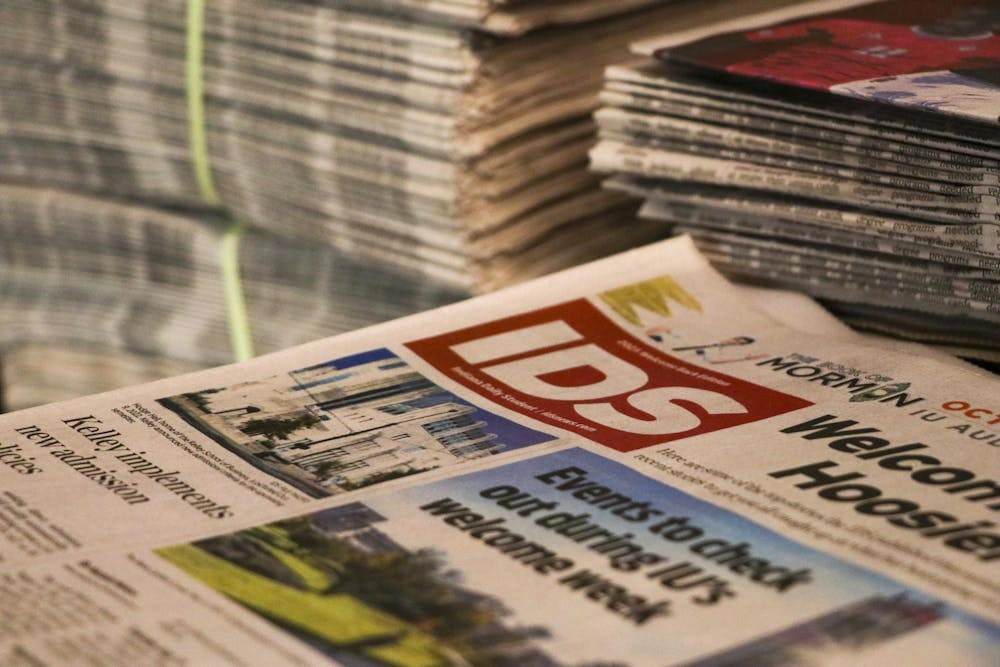
In early October, the Indiana Daily Student Newspaper (IDS) at Indiana University Bloomington received a directive from the IU Media School Administration to cut all news coverage from their print issues.
At the time, IDS Adviser Jim Rodenbush refused to follow the directive, claiming it would be censorship if he did so.
Additionally, IDS Co-editors-in-chief Mia Hilkowitz and Andrew Miller requested that the Media School rescind the directive because they believed it was a First Amendment violation.
Following the pushback received from Rodenbush and the IDS, Media School dean David Tolchinsky terminated Rodenbush on Oct. 14. Moreover, the Media School released a new directive that completely cut all print issues of the IDS.
Amid Rodenbush’s firing and the release of both directives, The Media School faced extensive, public backlash with some even calling the directives blatant censorship.
However, in late October, the Media School rescinded the directives. While the IDS is now allowed to print, the effects the directives and the decisions made by the Media School had on the staff of the IDS, Rodenbush and alumni is immense.
The Journal’s leadership team recently visited IU’s campus during the High School Journalism Institute’s summer workshop program. This opportunity introduced us to IU’s rich and robust journalism program.
But upon discovering this First Amendment issue, we set out to tell this story to amplify voices that are at risk of being silenced.
We also hope that each segment of this story provides insight to the visible and hidden layers of this situation to our school community.
To cover these events, we interviewed three key figures involved in this situation.
We also requested an interview with Tolchinsky via email, but we received no response.
Jim Rodenbush, former IDS adviser
As the words from his termination letter were read, Rodenbush tried to leave the room.
Regardless, he was mandated to listen, engulfed in shock, as they continued reading off the paper of his final meeting.
“One minute you’re operating in a structure where the student media has all the freedoms that it’s ever had … ,” Rodenbush said. “Then, seemingly, the very next day, everything has changed.”
Rodenbush, former Director of Student Media at IU, was fired by administration after his refusal to eliminate parts of the publication’s content. Since his removal, he’s gained support nationwide.
Rodenbush says he represented the final person who pushed back on the administration.
“That decision, the day after I was fired, to me, showed what the intent was because they got rid of the one person who was in the way,” Rodenbush said.
Upon his dismissal, this has sparked controversy and attention around the nation.
He has received a vast amount of support as the journalism community continues to rally behind him, from a standing ovation at a national journalism convention to countless supportive emails in his inbox.
Despite the outcomes, he says he hasn’t rethought anything because freedom of speech is nonnegotiable.
Moving forward, Rodenbush hopes to leave a lasting message for the future of journalists.
“ … Things that you’re used to in freedoms can be taken away instantly if you’re not paying attention,” Rodenbush said. “ … Get involved and speak up because I think it’s very important that advocacy for journalism, particularly student journalism, keeps going.”
Mia Hilkowitz, co-editor-in-chief of the IDS
As co-editors-in-chief of the IDS, Hilkowitz and Andrew Miller played a vital role in securing printing rights for their publication. As early as when the initial directive was released, Hilkowitz and Miller were asking for it to be repealed.
Instead, the Media School decided to terminate Rodenbush and release the new directive that cut the print issue. Hilkowitz says the decisions upset her.
“…I came (specifically) to IU because of its really rich history of press freedom and the support that the IDS student media got,” Hilkowitz said. “And so I was very, very angry and sad and hurt that this was happening at my school and then happening to me and my friends.”
Even in the face of adversity, she and Miller used their voices to educate the community and world about what was occurring.
Since the release of the first directive and Rodenbush’s termination, Hilkowitz and Miller have published three letters from the editors on the IDS website that have explained the situation.
Furthermore, media outlets, such as The New York Times and NBC News, have conducted interviews with Hilkowitz and Miller to explain their story.
“We were willing to come and share our side of the story when administrators wouldn’t,” Hilkowitz said. “…And IU, they wouldn’t say anything besides these really superficial press releases in short statements. And so I think we handled it very well because we went out there and showed people that as the IDS, we have nothing to hide.”
Amid the chaos, Hilkowitz still wants to pursue a career in journalism because more than anything, the situation has reaffirmed her belief of how important it is.
While the IDS is safe for now, she knows that there is still more to come. However, she hopes their fight helps others feel inspired to do the same.
“I call this one of the first battles of the overall war that’s probably going to be a years-long issue between the IDS student media and IU,” Hilkowitz said. “But because we were able to win (the first battle), I think I hope it inspires other journalists across the country to fight back on their own as well. So I think it’s a good sign.”
Ryan Gunterman, Indiana High School Press Association (IHSPA) Executive Director
When Gunterman discovered the unfolding story of Rodenbush’s removal, he felt ‘pure rage.’
To him, it was instinctive that the blame fell on the wrong person.
Gunterman knew that Rodenbush committed no crime or wrongdoing even if the narrative was meant to read that way.
Deep down, Gunterman believed that the university’s decision to terminate Rodenbush was motivated by his devotion to his students.
“It wasn’t because Jim did something that hurt the IDS or hurt the students,” Gunterman said. “It was because the university wanted to punish him for doing something for the students.”
Even though emotions were high, Gunterman held off on voicing his thoughts publicly because he was aware that responding based on his feelings could lead to regret.
So he decided to process everything first. But before he could craft a productive response, the IDS’ print edition was cut which ultimately ‘reset the cycle’ for Gunterman.
In the midst of all the noise, the IHSPA was planning their state convention.
According to Gunterman, IU and their Media School were one of the most prominent sponsors and exhibitors. He says that they’ve bought every sponsorship, underwriting and advertising opportunity for this event.
But he knew that the audience would be aware of IU’s ‘unethical’ actions, and he didn’t want to ignore the truth that their course of action was contradictory to IHSPA’s core values.
“It’s very disingenuous to say we want everybody to have complete First Amendment freedom and we want student journalists to be protected and then turn around and take money from people who are not doing that,” Gunterman said.
So in the days following, a statement in response to IU’s initiative was formulated. Gunterman and the IHSPA Executive Board engaged in thoughtful discussion, reflected on feedback and took a vote to ensure that everyone was in agreement with the IHSPA’s hopeful course of action. 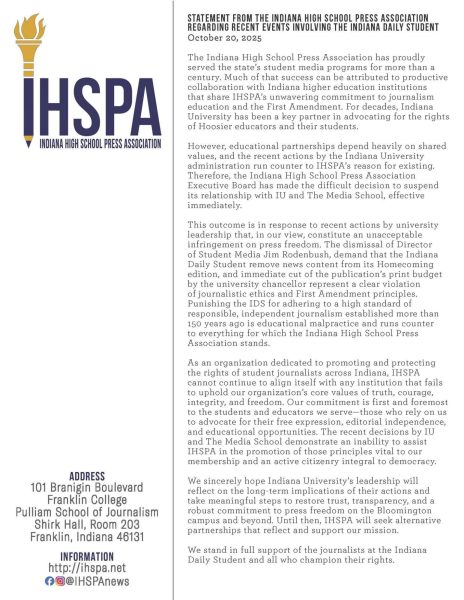
In this statement, the IHSPA voiced their decision to suspend their partnership with IU and The Media School. Their statement was then published on Oct. 20, 2025 and became effective immediately.
“As the voice of Indiana Scholastic journalism, we had to take the stand,” Gunterman said. “And we couldn’t just simply watch and wait and see what happens.”
Gunterman even says that at the fundamental level, they don’t want to be associated with IU in any way.
He doesn’t take this situation lightly, considering his personal tie to IU as a former editor-in-chief of the IDS and an alumni of the university.
But he has not let this profound connection to his alma mater cloud his logic.
Gunterman has stayed vigilant, and he believes that as this situation turns to the future, it will only escalate, but in a hushed tone.
Even though IU reversed it’s course and restored the IDS’ printing editions, Gunterman believes that their turnaround was only initiated to ‘buy themselves a little bit of time.’ He senses that there are changes waiting to take the reins.
“Rather than coming through with a sledgehammer of censorship and suppression, they’re just going to do it a little less publicly,” Gunterman said.
But he has faith that the students fighting this battle can claim victory. In his 25 years of teaching, Gunterman says that the students have always been the ones to give him hope. He’s seen students reverse bad situations and resolve them.
“The students are always in the right here, even though they’re dealing with people who are very confidently wrong and just louder than they are…,” Gunterman said.
He also warns the public to stay attentive to this evolving issue because the possibility of its expansion is present.
“If it can happen at the IDS, it can happen anywhere. Stay vigilant,” Gunterman said. “Don’t get complacent with this.”


Andy • Dec 4, 2025 at 12:51 pm
Firing Rodenbush crazy ngl. He did nothing wrong. #FreeRB